Pages

Thursday, November 30, 2023

Information on Managing Wild Blueberry Fields when Farm Gate Prices are Low


Hi, everyone

This production season is a very challenging year for the wild blueberry industry. Due to many significant weather events, Nova Scotia’s wild blueberry yield was down (Est. 38 million lbs, about a 33% reduction from last year) in 2023 and on top of that, we are seeing low farm gate prices.

A low farm gate price impacts the farm's financial situation in the current season and brings up challenges for future seasons’ management. Many of you already started thinking about next season’s management input, but are unsure what the blueberry market and price might look like next year, which can be stressful and challenging.  

In this post, I want to share some information to help with your planning and your personal wellness.

Yes, farming is full of uncertainties and challenges, but there are hopes. After mowing your fields, a new production cycle will start, that’s hope; When you start to see new sprouts in the spring, that’s hope; When you observe bees working hard around blueberry blooms, that’s hope. There will be good years ahead of us, let’s keep our hopes up!


Supporting the Mental Health of Nova Scotia Farmers

We Talk, We Grow. https://wetalkwegrow.ca/.

I hope you take care of your wellbeing and if you need support to get through this challenging time, there is a good resource developed by Farm Safety Nova Scotia. Please go to their website, and find the information or contacts for your needs.


Two Useful Wild Blueberry Factsheets


In 2017, Perennia published two factsheets related to managing wild blueberry fields when farm gate prices are low.

Managing Good Wild Blueberry Fields when Farm Gate Prices are Low: this factsheet focuses on how to manage good wild blueberry fields. https://www.perennia.ca/wp-content/uploads/2018/04/managing-good-wild-blueberry-fields-when-field-prices-are-low.pdf.


Integrating Rest Periods into a Wild Blueberry Production Cycle: many of you might want to rest fields or cut inputs. This factsheet introduces some great points and things to consider while resting fields, especially on weed management. https://www.perennia.ca/wp-content/uploads/2018/04/integrating-resting-wbb-fields.pdf. Resting fields doesn’t mean you should forget about the weed management program as by the time you want to bring those fields back to production, the recovery cost could be high. A minimum weed management input is recommended if you want to continue production in the near future.

A minimum weed management input can be mowing, cutting above-canoy weeds and repeated cutting throughout the growing season, spot treatment (spreading dogbane, goldenrods etc.) and selecting low-price herbicides for major weeds (sheep sorrels, hair fescues, goldenrods, annual grasses etc.).
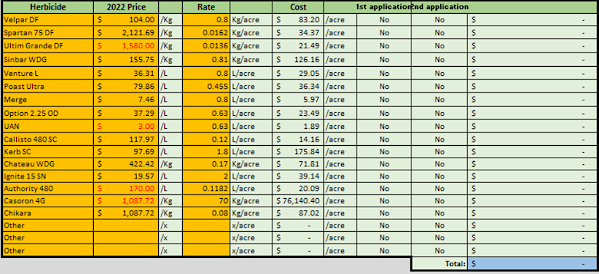


This 2022 herbicide price table can be found under the wild blueberry management tool, and you will also find other chemical and fertilizer prices. I strongly recommend you use this tool and plan your input based on your comfort level.

Management Tool: Go to: https://nswildblueberries.com/., Click on Grower Resources, then click on “Management Tool”. The Excel sheet will be downloaded automatically.


Please feel free to reach out to me if you need to get a second opinion on your input planning.


Thank you!


Hugh Lyu, Wild Blueberry Specialist, Perennia

hlyu@perennia.ca

902-890-0472.

Wednesday, November 1, 2023

November Wild Blueberry Management Reminder

Hi,

It is November! Temperatures are cooling off and a cool environment offers great opportunities for some fall wild blueberry management, including Kerb application for hair fescue control.

Kerb Application- Hair fescue management

Some of you might be thinking of applying Kerb in the whole field or just spot spray. We are in a good timing for the Kerb application across the NS. The optimum timing to apply Kerb is when the soil temperature is between 0-10 °C and a forecasted rain event in a few days after the application. Moisture is helpful to move Kerb into the soil. This fall’s weather conditions offer a great opportunity to control hair fescue with Kerb, because of a cool fall and enough moisture under the ground to move Kerb into soil. Please refer to Table 1 for the closest weather station near the fields of interest.

Mosses Control

This year’s wet conditions have created many challenges and one of them is more wet grounds in wild blueberry fields. Wet grounds are ideal for moss to spread.

Large water-sitting areas in a wild blueberry field


After mowing crop fields, growers can apply Chateau to manage mosses. Chateau WDG is used as a dormant post-harvest application.

Unacceptable crop injury and yield loss may occur if the product comes into contact with non-dormant structures. Make sure the spray tank is cleaned according to label recommendations before applying a foliar pesticide. Do not make more than two applications in a growing season. Use a low rate in coarse-textured soils, and a high rate in medium-textured soils.

When growers are able to get into fields and start spring spraying activities, it is in April. Wild blueberry plant emergence could start early and a spring application of Cheatuae could damage newly emerged plants. Springtime is a more risky time to apply Chetaue also due to a higher chance of more water sitting in the blueberry ground when snow starts melting. Herbicides could end up sitting in the water.

Sprout fields’ yield potential


A visit to your sprout fields is recommended this time of the year. You should assess if this spring and summer’s weed management is successful. Weed species observed at this time of the year should be your next spring’s crop fields' weed management priority. You can also assess if this summer’s fungicide program is good. Because of a wet summer, most growers applied at least one fungicide but commonly two applications were observed. Fields treated with two applications are generally healthy and fields maintain leaves.

Please pick a few stems and check their fruit buds (those large buds). Generally speaking, an average of 5-6 buds per stem would be considered good. In some well-managed fields, 10 fruit buds per stem are common to see. This information is useful to determine next year’s input, such as pollination needs.


Crop fields weed management


The only weed species I want to mention is sheep/red sorrel. It appears in every field I visited, sprout and crop fields. Due to the excessive moisture, they have a great year to grow. The management of sheep sorrel will become an important activity on your weed management list. Here are a few points to help you.

·         According to some new research data, it is suggested that fall is not an ideal time of the year to control sheep sorrel with Spartan. Plants recovered from seed in the following year. We suggest grower apply Spartan in the spring  before plant emergence starts.

·         If you observe large sheep sorrel plants, Spartan is the only effective herbicide that controls mature and established plants.

·         In the spring, before you apply Spartan, check if there are many small seedlings next to mature sheep sorrel, if that’s the case, you can consider a tank mix of Spartan and Authority which controls both seedlings (newly emerged sheep sorrel) and mature plants.

·         We recommend growers apply Spartan according to spring sprout fields’ plant emergence situation- apply before plant emergence or up to 10% emergence. The GDD tool suggests to apply it in between 150-200 GDD.

Table 1. Soil temperatures across the 44 wild blueberry weather stations, as of November 1, 2023

Weather Stations

Soil Temperatures as of November 1, 2023, °C.

Colchester

Glenholme (NSW001)

5.6

Murray Siding (NSW002)

6.8

Keble (NSW020)

6.4

Upper Kemptown (NSW022)

6.1

Kavanaugh Mills (NSW023)

6.2

Debert (NSW036)

4.8

Belmont (NSW037)

6.3

Staples Brook (NSW038)

7.2

Eastville (NSW067)

6.6

Benvie Hill (NSW068)

8.9

Belmont (NSW087)

5.7

Earltown (NSW089)

5.9

Camden (NSW090)

3.2


Cumberland

Halfway River (NSW039)

5.4

Wentwoth (NSW076)

7.1

Salt Springs (NSW077)

4.3

East Mapleton (NSW078)

4.9

Gilbert Mountain (NSW79)

5.7

Yorke Settlement (NSW080)

6.0

North Greville (NSW081)

5.7

Kirkhill (NSW082)

5.9

West Advocate (NSW091)

8.4

Westchester Station (NSW094)

6.9


Pictou

Blue Mountain (NSW017)

7.0

Sunny Brae (NSW018)

5.0

New Gairloch (NSW019)

6.3

Four Mile Brook (NSW021)

6.6

Glencoe (NSW057)

6.3

Sunny Brae (NSW058)

6.4

Blanchard Road (Nsw059)

6.5

Blue Mountain (NSW060)

6.2

Moose River (NSW061)

7.4

Hazel Glen (NSW086)

7.3


Antigonish

New France (NSW075)

5.4


South Shore Counties

New Tusket (NSW024)

7.0

East Kemptville (NSW025)

6.6

West Caledonia (NSW026)

7.5

Milford (NSW027)

7.8


Cape Breton

Skye Mountain (NSW028)

4.3

Keppoch (NSW029)

5.9


Hants and HRM

Dean (NSW069)

6.8

Woodside (NSW070)

7.8

Chaplin (NSW071)

6.2

Upper Rawdon

7.0